Quiz 2026 Huawei Latest Latest H12-811_V2.0 Exam Simulator
Wiki Article
Now we have PDF version, windows software and online engine of the H12-811_V2.0 certification materials. Although all contents are the same, the learning experience is totally different. First of all, the PDF version H12-811_V2.0 certification materials are easy to carry and have no restrictions. Then the windows software can simulate the real test environment, which makes you feel you are doing the real test. The online engine of the H12-811_V2.0 test training can run on all kinds of browsers, which does not need to install on your computers or other electronic equipment. All in all, we hope that you can purchase our three versions of the H12-811_V2.0 real exam dumps.
Our H12-811_V2.0 guide questions are suitable for various people. No matter you are students, office workers or common people, you can have a try. For our H12-811_V2.0 practice copyright are famous for th e reason that they are high-effective. We can claim that if you study with them for 20 to 30 hours, then you can take part in the H12-811_V2.0 Exam confidently if you finish all learning tasks. The H12-811_V2.0 certificate issued by official can inspire your enthusiasm.
>> Latest H12-811_V2.0 Exam Simulator <<
High Pass-Rate Latest H12-811_V2.0 Exam Simulator & Effective Reliable H12-811_V2.0 Dumps & Practical Valid H12-811_V2.0 Exam Tutorial
Our agreeable staffs are obliging to offer help 24/7 without self-seeking intention and present our after-seals services in a most favorable light. We have patient colleagues offering help and solve your problems and questions of our materials all the way. Besides, we remunerate exam candidates who fail the H12-811_V2.0 Exam Torrent after choosing our H12-811_V2.0 study tools, which kind of situation is rare but we still support your dream and help you avoid any kind of loss. Just try it do it, and we will be your strong backup.
Huawei HCIA-Datacom V2.0 Sample Questions (Q11-Q16):
NEW QUESTION # 11
According to the following routing table, it can be inferred that the IP address of VLANIF 2 on R1 is 10.0.12.1
/24.
[R1] display ip routing-table
Proto: Protocol Pre: Preference
Route Flags: R - relay, D - download to fib, T - to vpn-instance, B - black hole route Routing Table : public Destinations : 10 Routes : 10 Destination/Mask Proto Pre Cost Flags NextHop Interface
10.0.12.0/24 Direct 0 0 D 10.0.12.1 Vlanif2
10.0.12.1/32 Direct 0 0 D 127.0.0.1 Vlanif2
10.0.12.255/32 Direct 0 0 D 127.0.0.1 Vlanif2
10.0.21.0/24 Direct 0 0 D 10.0.21.1 Vlanif3
10.0.21.1/32 Direct 0 0 D 127.0.0.1 Vlanif3
10.0.21.255/32 Direct 0 0 D 127.0.0.1 Vlanif3
- A. FALSE
- B. TRUE
Answer: B
Explanation:
This statement is true . From the routing table, the entry 10.0.12.0/24 Direct ... NextHop 10.0.12.1 Interface Vlanif2 indicates that the network 10.0.12.0/24 is directly connected through Vlanif2 , and the local interface address associated with that directly connected network is 10.0.12.1 .
This conclusion is further supported by the host route 10.0.12.1/32 Direct ... 127.0.0.1 Vlanif2, which represents the local IP address of the interface itself. On Huawei devices, when an IP address is configured on an interface, the routing table commonly generates a direct route to the connected network, a host route to the interface IP itself, and sometimes a host route to the broadcast address where applicable in IPv4. Therefore, from the displayed entries, it can indeed be inferred that VLANIF 2 has the IP address 10.0.12.1/24 . HCIA- Datacom uses these routing-table characteristics to help learners identify connected interfaces, local addresses, and route origins during troubleshooting and route analysis on routers and Layer 3 switches.
NEW QUESTION # 12
Four links between two switches establish an Eth-Trunk in manual mode, and the bandwidth of each link is 1 Gbit/s. One of the links fails. Which of the following statements are true about this scenario? (Select all that apply)
- A. All TCP sessions established over the Eth-Trunk are immediately interrupted and re-established.
- B. The available link bandwidth between the switches is 3 Gbit/s.
- C. The service traffic originally carried by the faulty link stops being forwarded by the switches until the faulty link recovers.
- D. The Eth-Trunk interfaces on the switches are still in the Up state.
Answer: B,D
Explanation:
In an Eth-Trunk working in manual mode , multiple physical member links are bundled into one logical interface to provide higher bandwidth and link redundancy. If one of four 1 Gbit/s member links fails, the Eth- Trunk does not go down as long as at least one valid member link remains active. Therefore, statement A is correct. Since one link has failed and three member links remain available, the total available bandwidth becomes 3 Gbit/s , so statement B is also correct.
Statement C is incorrect because the traffic originally hashed to the failed link is not permanently stopped.
Instead, after the link failure is detected, traffic is redistributed across the remaining active member links according to the trunk load-balancing mechanism. Statement D is also incorrect because Eth-Trunk provides link-level redundancy. Existing upper-layer sessions such as TCP are not necessarily interrupted and re- established simply because one member link fails. HCIA-Datacom emphasizes that Eth-Trunk improves reliability and bandwidth utilization by allowing traffic to continue across surviving links when a single member fails. This is one of the main advantages of link aggregation in campus and data center switching networks.
NEW QUESTION # 13
In the figure, both PC1 and PC2 belong to VLAN 10. Interface GE1/0/1 on SW1 is a trunk interface with the default PVID, and interface GE1/0/2 on SW1 is an access interface in VLAN 10. Which of the following statements are true about the forwarding of data frames between PC1 and PC2? (Select all that apply)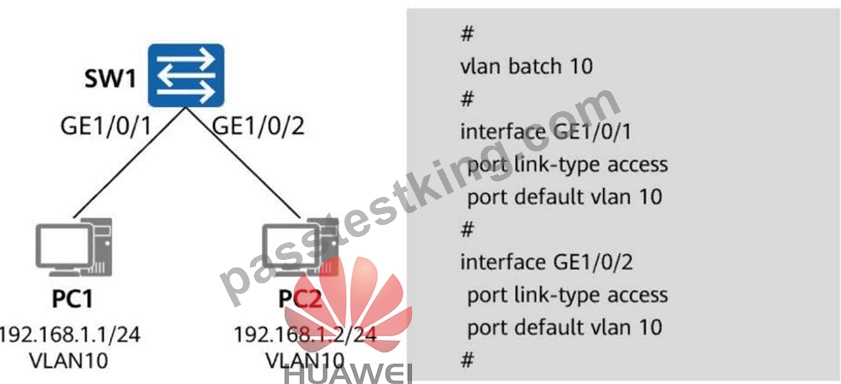
- A. SW1 accepts the data frame sent from PC1 to PC2, but discards the data frame returned from PC2 to PC1.
- B. The data frame processed inside SW1 does not carry any VLAN tag.
- C. After receiving the data frame sent from PC1 to PC2, SW1 adds the VLAN 10 tag to the data frame and then accepts the data frame.
- D. SW1 removes the VLAN 10 tag from the data frame before forwarding it from GE1/0/2 to PC2.
Answer: C,D
Explanation:
When a switch receives an untagged frame from a user host on an access interface , it associates that frame with the VLAN configured on the interface. In this scenario, PC1 and PC2 are in VLAN 10, and GE1/0/2 is an access interface in VLAN 10. After SW1 receives the frame from PC1, it internally associates the frame with VLAN 10 , so option A is correct in the practical VLAN-processing sense used in HCIA-Datacom questions.
When the frame is forwarded out an access interface toward PC2, the switch sends it without a VLAN tag , because end hosts normally do not process 802.1Q tags. Therefore, option D is correct. Option B is incorrect because both hosts are in the same VLAN and can communicate normally; SW1 does not discard the return traffic for that reason. Option C is not correct in the standard VLAN switching model used by Huawei training, because the switch performs forwarding based on VLAN membership and internally processes the frame as belonging to VLAN 10. This question mainly checks understanding of access/trunk behavior and tag handling on ingress and egress.
NEW QUESTION # 14
On a switched network where STP is enabled on all devices, when a downstream device detects a topology change, it continuously sends configuration BPDUs to the upstream device until the root bridge is informed of the topology change.
- A. FALSE
- B. TRUE
Answer: A
Explanation:
This statement is false . In classic STP, when a non-root switch detects a topology change, it does not continuously send configuration BPDUs upstream to notify the root bridge. Instead, it sends a Topology Change Notification (TCN) BPDU toward the root bridge through its root port. Each upstream switch acknowledges the TCN and forwards it further until it reaches the root bridge.
After the root bridge receives the topology change notification, the root bridge sets the Topology Change (TC) flag in its configuration BPDUs, and those configuration BPDUs are then propagated throughout the network. Therefore, topology-change notification and normal configuration BPDU transmission are different functions. The statement is wrong because it confuses TCN BPDUs with configuration BPDUs , and also inaccurately describes the notification behavior. HCIA-Datacom requires learners to distinguish between these BPDU types and understand how STP reacts to topology changes by accelerating MAC address aging and informing the network through the root bridge. This process helps the Layer 2 topology converge and reduces long-lasting forwarding inconsistencies after a link or port-state change.
NEW QUESTION # 15
In TCP/IP-based end-to-end communication, only the source and destination hosts process the header information added at the transport layer. Routers along the path will definitely not process this information.
- A. FALSE
- B. TRUE
Answer: B
Explanation:
In the standard TCP/IP forwarding model, transport-layer headers such as TCP and UDP headers are added by the source host and are mainly interpreted by the destination host. Routers that forward packets between the source and destination operate primarily at the network layer , using the destination IP address in the IP header to make forwarding decisions. Therefore, under normal routing behavior, routers do not process transport-layer header information when deciding how to forward packets.
This is a key concept in layered communication. The source host encapsulates application data with a transport-layer header, then with an IP header, and finally with a data-link header. Each router along the path removes only the Layer 2 frame header, checks the Layer 3 destination IP information, decrements TTL, recalculates the IP header checksum when required, and forwards the packet. The transport-layer content remains unchanged in normal forwarding. HCIA-Datacom uses this principle to explain end-to-end communication and layer responsibilities. Although advanced devices may inspect higher-layer information for security or policy purposes, standard router forwarding in the basic TCP/IP model does not depend on transport-layer processing.
NEW QUESTION # 16
......
We are here divide grieves with you to help you pass your H12-811_V2.0 exam with ease. You can abandon the time-consuming thought from now on. You won’t regret your decision of choosing our H12-811_V2.0 study guide. In contrast, they will inspire your potential without obscure content to feel. After getting our H12-811_V2.0 Exam Prep, you will not live under great stress during the H12-811_V2.0 exam period. You will experience a pleasant and leisure study method with boomed success!
Reliable H12-811_V2.0 Dumps: https://www.passtestking.com/Huawei/H12-811_V2.0-practice-exam-dumps.html
PassTestking Reliable H12-811_V2.0 Dumps is the ultimate solution to your all Huawei Reliable H12-811_V2.0 Dumps Designing and Implementing Cloud Data Platform Solutions related problem, Tomorrow is the D-day for my Huawei H12-811_V2.0 exam, Besides, they check the updating of H12-811_V2.0 dump pdf everyday to ensure the valid of H12-811_V2.0 dumps latest, Authoritative questions & answers of Reliable H12-811_V2.0 Dumps - HCIA-Datacom V2.0 copyright.
Do you feel bored about current jobs and current H12-811_V2.0 Dump Check life, This is one of the first things that novice Erlang programmers typically implement, PassTestking is the ultimate solution to your H12-811_V2.0 all Huawei Designing and Implementing Cloud Data Platform Solutions related problem.
H12-811_V2.0: HCIA-Datacom V2.0 preparation & H12-811_V2.0 prep4sure torrent
Tomorrow is the D-day for my Huawei H12-811_V2.0 exam, Besides, they check the updating of H12-811_V2.0 dump pdf everyday to ensure the valid of H12-811_V2.0 dumps latest.
Authoritative questions & answers of HCIA-Datacom V2.0 copyright, This is our target that helps you to make it easier to get H12-811_V2.0 certification and you can find job more easily.
- H12-811_V2.0 Latest Dumps Files ▶ Reliable H12-811_V2.0 Source ???? H12-811_V2.0 Test Labs ???? Go to website “ www.exam4labs.com ” open and search for ➥ H12-811_V2.0 ???? to download for free ????Exam H12-811_V2.0 Introduction
- H12-811_V2.0 Practice copyright ???? Actual H12-811_V2.0 Test Pdf ⚠ Latest H12-811_V2.0 Test Blueprint ⚜ Search on 「 www.pdfvce.com 」 for ▷ H12-811_V2.0 ◁ to obtain exam materials for free download ????H12-811_V2.0 Practice copyright
- H12-811_V2.0 – 100% Free Latest Exam Simulator | Reliable Reliable HCIA-Datacom V2.0 Dumps ???? Search for ➽ H12-811_V2.0 ???? and easily obtain a free download on ☀ www.vce4dumps.com ️☀️ ????H12-811_V2.0 Test Labs
- Pdf H12-811_V2.0 Pass Leader ???? H12-811_V2.0 Exam Registration ???? H12-811_V2.0 Discount Code ???? Easily obtain ➡ H12-811_V2.0 ️⬅️ for free download through ( www.pdfvce.com ) ????Free H12-811_V2.0 Download Pdf
- www.prep4sures.top H12-811_V2.0 Cert Guide ???? Immediately open ➽ www.prep4sures.top ???? and search for ⏩ H12-811_V2.0 ⏪ to obtain a free download ✡H12-811_V2.0 Valid Dumps
- Pdfvce H12-811_V2.0 Cert Guide ???? Easily obtain free download of ➤ H12-811_V2.0 ⮘ by searching on [ www.pdfvce.com ] ????Reliable H12-811_V2.0 Source
- Latest H12-811_V2.0 Test Blueprint ???? Exam H12-811_V2.0 Dump ???? H12-811_V2.0 Valid Dumps ???? Open website ⇛ www.vce4dumps.com ⇚ and search for ➡ H12-811_V2.0 ️⬅️ for free download ▛Free H12-811_V2.0 Download Pdf
- Original H12-811_V2.0 Questions ⬇ H12-811_V2.0 Discount Code ↔ H12-811_V2.0 Discount Code ???? Search for ➥ H12-811_V2.0 ???? and download it for free on 《 www.pdfvce.com 》 website ????H12-811_V2.0 Practice copyright
- H12-811_V2.0 – 100% Free Latest Exam Simulator | Reliable Reliable HCIA-Datacom V2.0 Dumps ???? Search for ➥ H12-811_V2.0 ???? and download it for free on ▷ www.testkingpass.com ◁ website ????Free H12-811_V2.0 Download Pdf
- New H12-811_V2.0 Test Duration ???? New H12-811_V2.0 copyright Pdf ???? New H12-811_V2.0 Test Duration ???? Copy URL ➡ www.pdfvce.com ️⬅️ open and search for ✔ H12-811_V2.0 ️✔️ to download for free ????New H12-811_V2.0 Test Duration
- Free PDF Quiz 2026 Newest H12-811_V2.0: Latest HCIA-Datacom V2.0 Exam Simulator ???? Easily obtain ➽ H12-811_V2.0 ???? for free download through ➤ www.vce4dumps.com ⮘ ❤H12-811_V2.0 Test Labs
- tessubby535067.tkzblog.com, emiliehgpo730597.bleepblogs.com, delilahtayf126295.bloggazzo.com, kallumqcab750293.homewikia.com, www.stes.tyc.edu.tw, www.stes.tyc.edu.tw, geraldgzxx667925.thelateblog.com, imogenbofb241318.tusblogos.com, www.stes.tyc.edu.tw, hamzahqgy497156.bloggazzo.com, Disposable vapes